


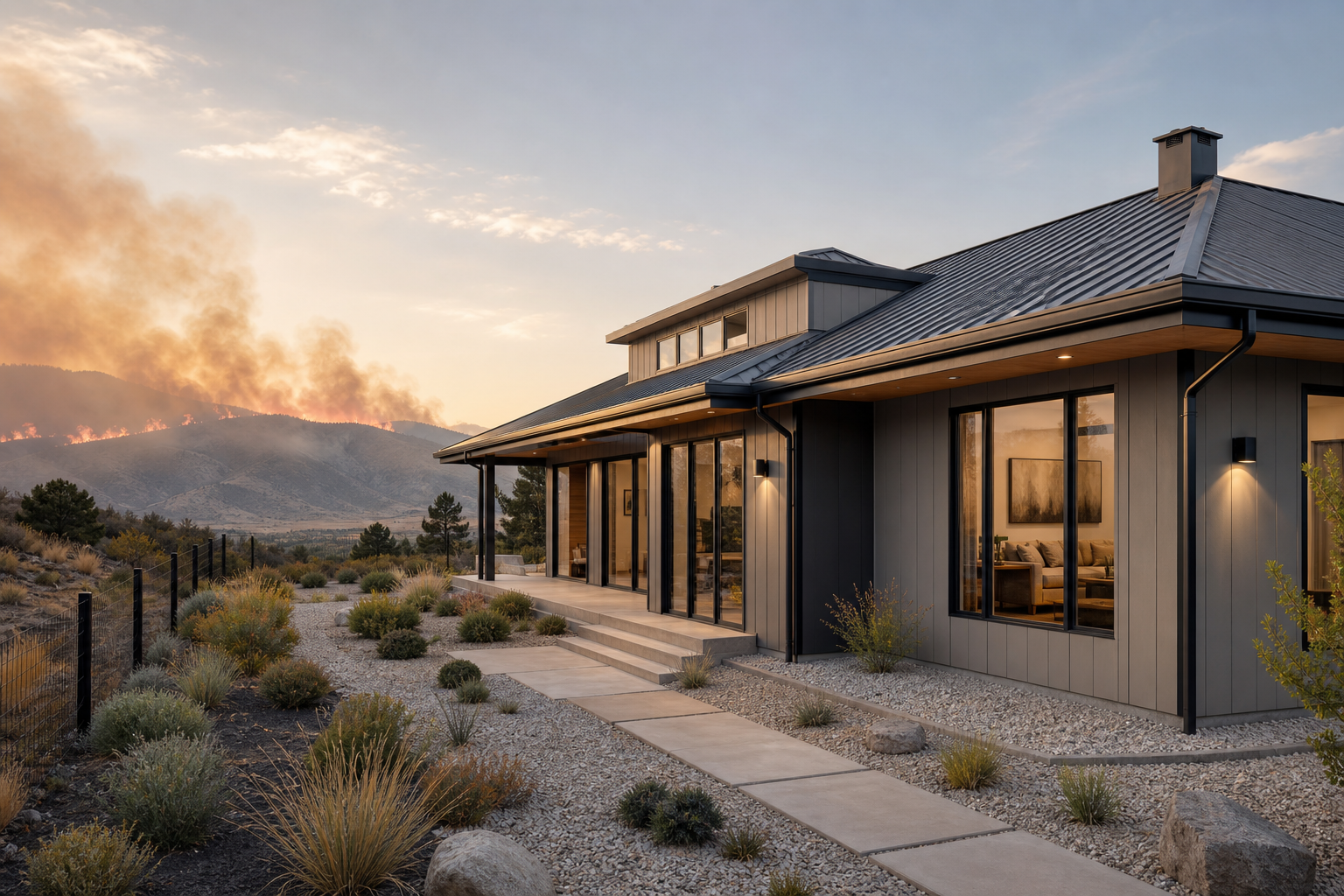
Keywords: wildfire-resistant homes, fire-resistant building materials, wildfire home hardening, ember-resistant vents, defensible space, prefab steel homes, resilient housing, Xhome
When people imagine a wildfire reaching a neighborhood, they usually picture a wall of flames.
In reality, many homes ignite before the main fire ever arrives.
Wind can carry burning embers more than a mile ahead of a wildfire. Those embers collect in gutters, enter attic vents, settle beneath decks, and ignite combustible materials near the home.
This changes the way wildfire-resistant housing needs to be designed.
A stronger structural frame is valuable, though no single material makes a home fireproof. Real resilience comes from the way the roof, walls, openings, landscaping, structure, and maintenance plan work together.
As wildfire risk affects more communities across the United States, fire resistance is becoming a whole-system decision.
Embers Are Often the First Test
A home does not need to be directly touched by flames to ignite.
Small embers can travel through wind-driven air and find vulnerable points throughout a building. An open vent, a dry leaf trapped in a gutter, or combustible furniture against an exterior wall can provide the starting point.
This is why wildfire home hardening begins with details that may seem small.
Vents need to resist ember entry. Eaves and soffits need to be enclosed and maintained. Gaps around roofs, siding, doors, and utilities need careful attention. Gutters and roof valleys must stay clear of debris.
During normal weather, these details are almost invisible.
During a wildfire, they can determine whether embers remain outside or reach combustible spaces inside the building envelope.
The Roof Is One of the Most Important Surfaces
The roof receives direct exposure to falling embers.
Class A-rated roof assemblies, including properly designed metal roofing systems, provide the highest level of fire resistance under standard roof testing. The roof covering still needs to work with correctly installed underlayment, flashing, edges, gutters, and penetrations.
A durable roof is not simply a sheet of noncombustible material.
It is an assembly.
Openings around skylights, vents, chimneys, and transitions must be designed and installed carefully. Debris must not be allowed to accumulate where wind carries it.
Good wildfire design connects material selection with construction quality and long-term maintenance.
The First Five Feet Can Change the Outcome
The area immediately surrounding a home deserves as much attention as the building itself.
California fire agencies and resilience organizations increasingly emphasize a noncombustible zone within the first five feet of the structure. Gravel, concrete, and other low-combustibility surfaces reduce the chance that nearby materials will ignite and expose walls, windows, or roof edges to sustained heat.
Firewood, dry vegetation, wood mulch, outdoor furniture, and other combustible items should not be stored against the home.
This does not require creating a property without landscape design.
It means treating the closest zone as part of the building's protective system.
Architecture and site planning cannot be separated when wildfire risk is involved.
Windows, Vents, and Eaves Need Equal Attention
Wildfire resilience often fails at openings.
Heat can break vulnerable glazing. Embers can pass through vents. Flames can become trapped beneath open eaves or overhangs.
Tempered multi-pane windows can improve performance compared with basic single-pane glazing. Ember-resistant vents help limit entry into attics and crawl spaces. Enclosed eaves reduce exposed surfaces where heat and embers can collect.
These components must be selected as part of the same design strategy.
A noncombustible wall provides limited protection if an adjacent opening allows fire into the structure.
The entire exterior envelope needs to respond together.
Where Light Steel Adds Value
Light-gauge steel framing is noncombustible. It does not provide fuel for a fire in the way combustible framing materials can.
That is an important advantage, though it must be understood correctly.
Steel can lose strength when exposed to extreme temperatures. A light steel frame still depends on tested wall assemblies, appropriate sheathing, insulation, fire-rated interior protection, reliable connections, and careful detailing around penetrations.
The value of steel is strongest when it is part of a complete engineered system.
For developers, steel also supports precision. Components can be digitally designed and manufactured to consistent dimensions, helping roof, wall, window, and utility details align with the construction documents.
In resilience-focused building, consistent execution matters as much as good intentions.
Prefab Can Improve Quality Control
Wildfire-ready details are easier to manage when they are planned before construction reaches the site.
Offsite manufacturing allows teams to coordinate wall assemblies, openings, structural connections, and material transitions in a controlled environment. Repeated details can follow documented production steps. Quality checks can happen while components remain visible and accessible.
Prefab does not replace local code review, site-specific engineering, or professional installation.
It can reduce variation.
That matters because small inconsistencies create vulnerabilities. A missing seal, an improvised opening, or an unprotected transition may become the weakest point in an otherwise strong design.
Repeatable production helps turn resilience from a list of recommendations into a construction process.
A Wildfire-Ready Home Must Remain Ready
Resilience is not finished when construction ends.
Leaves return to gutters. Plants grow closer to walls. Owners place furniture beneath windows. Vents and screens can become damaged.
A wildfire-ready property needs a maintenance plan that is understandable and realistic.
Homeowners should know which zones must remain clear, which exterior components require inspection, and which modifications could increase risk. Developers and manufacturers can support this by documenting the intended performance of the home and providing straightforward maintenance guidance.
The best resilience strategy is one people can continue using years after move-in.
Where Xhome Fits Into the Conversation
At Xhome, we view housing performance as the result of connected systems.
Our light steel prefab approach supports precise engineering, controlled manufacturing, and coordinated assemblies. For projects in wildfire-prone regions, those capabilities can be combined with appropriate roof systems, exterior materials, vents, glazing, defensible-space planning, and local fire requirements.
No home can be described responsibly as wildfire-proof.
A home can be designed to reduce vulnerabilities, resist common ignition pathways, and give occupants and communities a stronger level of protection.
That is the standard modern resilient housing should pursue.
Final Thoughts
Wildfire-ready housing is not one product.
It is a chain of decisions.
The roof must resist embers. Vents must protect openings. Walls and windows must manage heat exposure. The first five feet around the home must reduce nearby fuel. The structural system and protective assemblies must be engineered to work together.
Light steel can be an important part of that strategy.
Precision manufacturing can make the strategy easier to repeat.
But resilience comes from the whole home.
As wildfire risk becomes part of housing decisions in more regions, the most valuable homes will not only be beautiful and efficient.
They will be designed for the conditions they may face.
Learn more: U.S. Fire Administration wildland-urban interface resources; NIST wildland-urban interface fire research; CAL FIRE home-hardening guidance; IBHS Wildfire Prepared Home.


