


Keywords: buildability, prefab housing, construction labor shortage, light steel framing, design for manufacturing and assembly, offsite construction, housing affordability, Xhome
For years, the housing industry has treated design and construction as two separate conversations.
Architects design the home. Engineers make it stand. Contractors figure out how to build it.
That sequence is becoming harder to defend.
In 2026, builders are working through a difficult combination of labor constraints, high development costs, cautious buyers, and slower housing activity. The U.S. Census Bureau reported that total housing starts fell sharply in May, while the Associated Builders and Contractors estimates that the industry still needs to attract 349,000 net new workers this year to meet demand.
The market needs homes that are affordable to deliver, not only attractive to approve.
That is why buildability is becoming one of the most important features in residential design.
What Does Buildability Mean?
Buildability is the degree to which a design can be constructed clearly, efficiently, safely, and predictably.
A buildable home is not necessarily simple. It can still be distinctive, spacious, and architecturally ambitious.
The difference is that its geometry, structure, materials, connections, dimensions, and installation sequence have been considered before crews arrive on site.
Good buildability reduces the number of decisions that must be improvised in the field. It gives fabricators clearer information. It helps trades coordinate their work. It makes quantities easier to estimate and schedules easier to manage.
In a market where time and labor are expensive, that clarity has real value.
The Labor Shortage Changes the Design Brief
A housing design that depends on unlimited skilled labor is no longer realistic in many markets.
Experienced tradespeople remain essential, but contractors cannot assume that every project will have the same crew availability, local knowledge, or schedule flexibility. Retirements, regional demand, and competition from infrastructure and commercial projects continue to pressure the labor supply.
This changes what a successful set of drawings must accomplish.
Drawings should not only communicate the appearance of the home. They should reduce unnecessary site work.
Can repeated wall assemblies use the same details? Can openings align with a framing system? Can components arrive in an installation sequence? Can difficult connections be resolved before fabrication? Can one trained crew assemble more of the structure with fewer field modifications?
These are design questions now.
Why More Custom Does Not Always Mean More Valuable
Custom design is often associated with quality.
But customization without discipline can create hidden costs.
Every unique dimension, unusual junction, late material change, and one-off connection adds another point that must be coordinated. Some of those decisions improve the home. Others simply increase the number of ways the project can go wrong.
The most effective housing systems distinguish between meaningful choice and unnecessary variation.
Buyers may value different layouts, facade materials, finishes, storage options, and outdoor spaces. They are less likely to value a structural detail that requires a crew to solve a new problem on every unit.
A well-designed platform can preserve visible flexibility while standardizing the parts buyers never need to think about.
That is not a reduction in design quality.
It is design maturity.
Buildability Begins Before the Permit Set
Many construction problems are already embedded in a project before the final drawings are issued.
If the structural grid conflicts with the room layout, the framing becomes complicated. If plumbing locations move repeatedly, coordination expands. If material sizes are ignored, cutting and waste increase. If transportation limits are considered too late, prefabricated elements may need to be redesigned.
Buildability works best when architecture, engineering, manufacturing, logistics, and site installation begin coordinating early.
This does not mean every detail must be fixed on day one.
It means the project needs rules.
A dimensional system. A structural logic. A repeatable set of openings. Clear service zones. Known shipping constraints. Defined tolerances. A realistic assembly sequence.
Those rules create a framework inside which design can move faster.
Prefab Turns Drawings Into Production Information
Traditional drawings describe what a finished building should become.
Prefab requires another layer: information that tells a production system how to make the parts.
Wall panels, floor systems, roof assemblies, and structural components must be coordinated with exact dimensions, connection points, labels, and order of installation. The model becomes more than a presentation tool. It becomes part of the manufacturing workflow.
This is one reason prefab can improve predictability.
Questions that might otherwise appear on site are pushed earlier, when they are easier and less expensive to resolve. Repeated components can be checked once and improved across multiple units. Material quantities become clearer. Fabrication and site preparation can advance in parallel.
Prefab does not make design less important.
It makes design decisions more consequential.
Why Light Steel Supports Design for Assembly
Light-gauge steel is well suited to a buildability-first approach because it can connect digital design directly to precise fabrication.
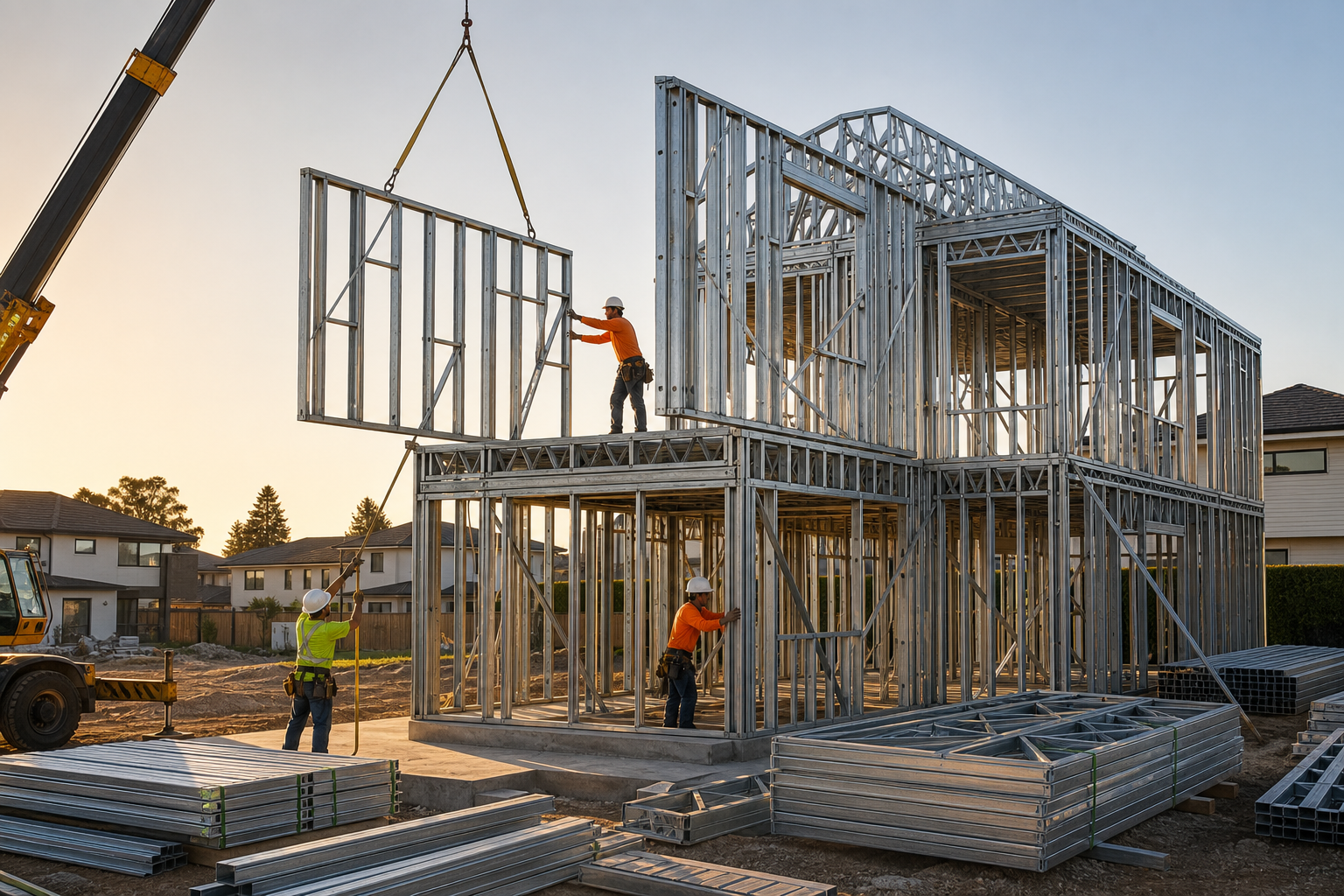
Studs, tracks, joists, and trusses can be engineered, formed, cut, punched, labeled, and packaged according to coordinated production information. Repeated profiles and connection details create consistency across the structure.
Steel also supports accurate openings and predictable geometry. That matters when windows, doors, exterior systems, mechanical routes, and interior finishes must align with the frame.
On site, organized components and panelized assemblies can reduce measuring, cutting, and correction work. Crews still need skill, but more of that skill can be focused on safe assembly and quality control rather than solving incomplete details.
The result is not merely faster framing.
It is a more legible construction process.
Buildability Is Also a Cost-Control Strategy
Housing affordability is often discussed in terms of material prices or land costs.
Those are important, but project uncertainty also carries a cost.
Unclear details create requests for information. Late changes create rework. Complex sequencing extends equipment rentals and supervision. Schedule delays increase financing and carrying costs. Material waste raises both purchase and disposal expenses.
Buildability helps reduce these risks before they compound.
It allows developers to compare options earlier. It gives estimators a clearer scope. It supports more reliable procurement. It makes repeated projects easier to forecast.
No construction system can eliminate uncertainty.
But a design that anticipates production can keep ordinary complexity from becoming avoidable cost.
What Developers Should Ask Before Approving a Design
Developers should evaluate a home as both a product and a process.
How many unique structural conditions does it contain?
Which components can be repeated?
Where will trades compete for the same space?
Can major assemblies be fabricated before site work is complete?
Are transportation and lifting requirements understood?
Does the design depend on unusually scarce labor?
Can the same technical system support multiple elevations or floor plans?
How much field cutting and adjustment should be expected?
These questions do not replace design review.
They reveal whether the design can survive contact with the real construction market.
Where Xhome Fits
At Xhome, we approach housing as a coordinated path from design through fabrication and assembly.
Our light steel prefab system is intended to make structural information clearer, components more repeatable, and site installation more predictable. The goal is not to remove architectural choice. It is to place that choice on top of a construction system that can be understood and delivered.
This matters for single-family homes, ADUs, infill projects, and communities where developers need both design quality and schedule control.
As housing markets become more demanding, the strongest projects will not be the ones with the most complicated drawings.
They will be the ones that turn good design into a reliable building process.
Final Thoughts
The next generation of home design will be judged by more than appearance.
Homes must respond to affordability pressure, limited labor, shorter schedules, material efficiency, resilience, and the need to deliver housing at greater scale.
That makes buildability a design feature.
When manufacturing and assembly are considered early, prefab systems can offer more than speed. They can create clarity across the entire project.
In 2026, that clarity may be one of the most valuable forms of innovation in housing.
Sources: Associated Builders and Contractors 2026 workforce estimate; U.S. Census Bureau New Residential Construction, May 2026; Harvard Joint Center for Housing Studies, The State of the Nation's Housing 2026.


