


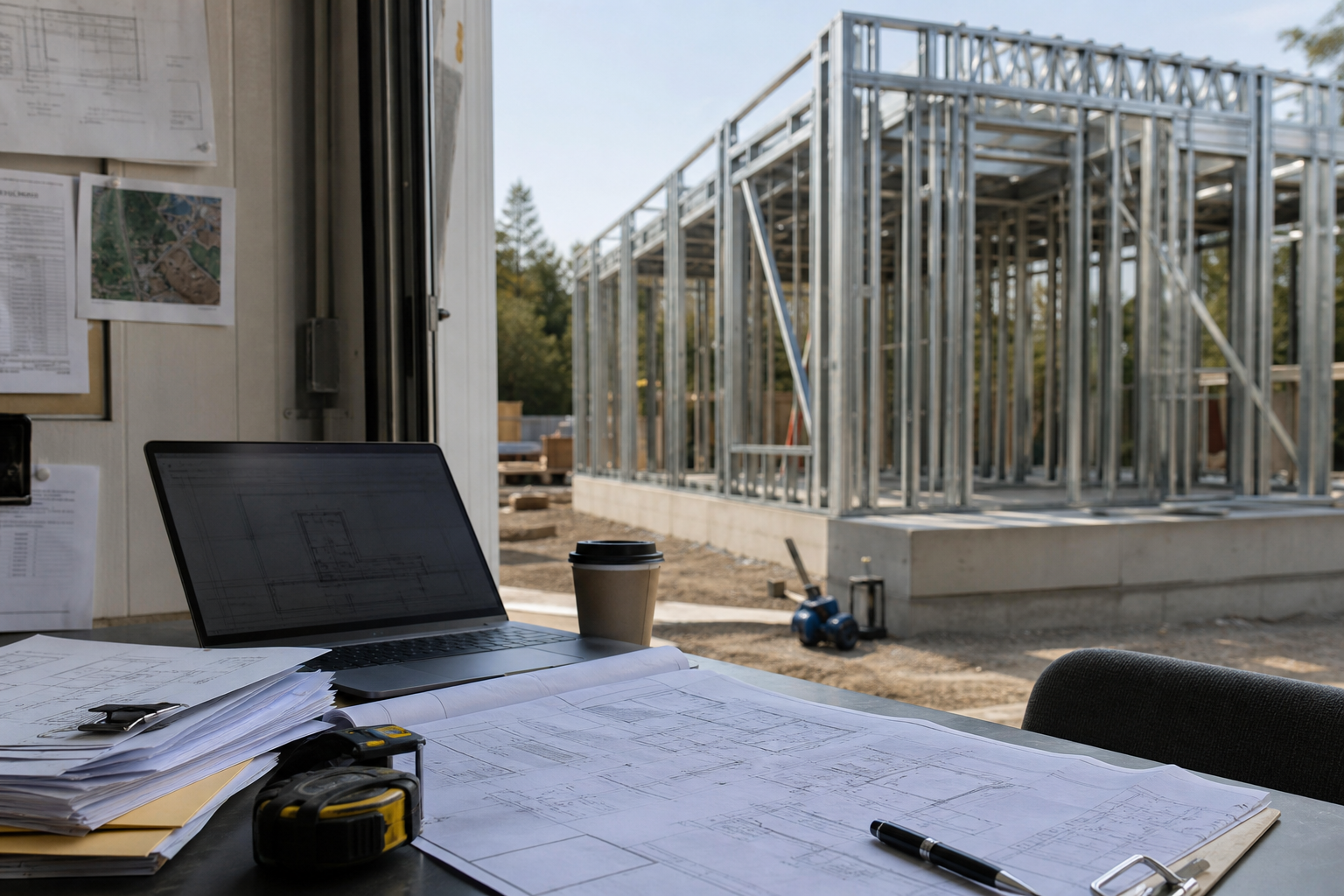
Keywords: preapproved building plans, preapproved home plans, prefab housing, faster permitting, housing affordability, light steel homes, offsite construction, Xhome
For years, the housing conversation has focused on one big question.
How do we build more homes?
The answer is often framed around land, labor, materials, zoning, or interest rates. All of those matter. But one part of the process is getting new attention from cities, builders, and housing researchers: the plan review itself.
Across the United States, a growing number of jurisdictions are exploring preapproved building plans as a practical way to reduce delays and make smaller housing projects easier to deliver.
The idea is simple.
Instead of starting from zero every time, a city reviews a set of housing plans in advance. Builders and homeowners can then use those plans for eligible projects, with site-specific review still required where needed.
It is not a shortcut around safety.
It is a way to make good housing designs easier to repeat.
Why Preapproved Plans Are Gaining Attention
Preapproved plans are becoming more relevant because the cost of delay has become harder to ignore.
In June 2026, the National Association of Home Builders reported that regulations at the federal, state, and local levels add an average of $131,734 to the price of a new single-family home. That equals 26.4% of the average sales price.
Not every regulation is unnecessary. Building codes, fire safety, accessibility, energy performance, drainage, and structural standards all serve important purposes.
The challenge is uncertainty.
When review timelines are unpredictable, costs move. Financing continues. Labor schedules shift. Materials may change price. A project that looked feasible at the beginning can become harder to justify before construction even starts.
Preapproved plans do not solve every cost problem.
They do address one important piece: repeated design review for familiar housing types.
What a Preapproved Plan Actually Does
A preapproved plan is a reusable set of drawings and specifications that has already been reviewed by a local government or relevant authority.
That does not mean a builder can ignore the site.
Every property still has its own conditions. Setbacks, utility connections, grading, drainage, soil, snow load, wind exposure, fire requirements, and local installation details may still require review.
But the core design has already passed through an approval process.
This can reduce duplicated work. It can make the expectations clearer for builders. It can help homeowners understand what is realistic before they spend heavily on custom design. It can also help cities encourage the types of housing they want to see more often, such as accessory dwelling units, small infill homes, duplexes, or compact single-family models.
In other words, preapproval turns a housing design from a one-off question into a repeatable option.
Why Standardization Does Not Mean Boring Homes
Standardization is sometimes misunderstood.
People hear the word and imagine every home looking identical.
That is not how strong housing systems work.
The most useful standardization often happens behind the walls. Structural grids, wall assemblies, utility pathways, roof details, window openings, and connection points can follow tested patterns while the visible design still allows variation.
A home can have different finishes, facade treatments, layouts, and site responses while still relying on a consistent technical system.
This matters because the hidden parts of a home are often where time and cost uncertainty appear.
If every wall, connection, and opening is redesigned from the beginning, teams must repeatedly solve problems that could have been handled once and reused intelligently.
Preapproved plans make the repeatable parts visible.
Where Prefab Construction Fits In
Prefab housing and preapproved plans are natural partners.
A preapproved plan creates a clearer design path. Offsite construction creates a more controlled production path.
When the same design information moves from approval into manufacturing, the process becomes easier to coordinate. Materials can be planned earlier. Components can be produced with more precision. Installation teams can work from a familiar set of details.
This does not remove local permitting or professional oversight.
It reduces variation between design, review, production, and assembly.
That is especially useful for developers building multiple homes across similar sites. A repeatable system helps teams estimate cost, schedule work, and manage quality with more confidence.
In a market where uncertainty is expensive, predictability becomes part of the product.
Why Light Steel Supports Repeatable Housing Systems
Light-gauge steel works well with this shift because it is designed for precision.
Steel framing components can be digitally modeled, engineered, and manufactured to consistent dimensions. Openings can align with the plan. Connections can be coordinated before materials arrive on site. Wall and roof assemblies can be documented as part of a repeatable system.
For developers, this consistency matters.
It can reduce field improvisation. It can make installation easier to train. It can support performance requirements across different climates when engineering is adapted for local conditions.
Light steel also connects well with modern prefab production because the material is strong, dimensionally stable, and compatible with digital fabrication workflows.
Again, the point is not that one material solves every housing challenge.
The point is that repeatable housing needs repeatable components.
What Cities Gain From Preapproved Plans
Cities are under pressure to add housing without overwhelming planning departments.
Preapproved plans can help by giving staff, builders, and residents a shared starting point.
Instead of reviewing every project as a completely new design, officials can focus more attention on site-specific questions. That can improve clarity for applicants and reduce administrative friction for common housing types.
For smaller projects, the benefit can be especially meaningful.
An accessory dwelling unit or compact infill home may not have the budget to absorb long custom design cycles. If the approval path is clearer, more homeowners and small builders may be able to participate in housing production.
This is why preapproved plans are not only a design tool.
They are a capacity tool.
What Preapproved Plans Cannot Do
It is important not to overstate the idea.
Preapproved plans will not fix land shortages. They will not eliminate high interest rates. They will not replace zoning reform. They will not solve infrastructure limits or local opposition by themselves.
They also cannot turn every site into an easy build.
Some lots need custom engineering. Some communities have environmental, fire, flood, or slope conditions that require additional review. Some buyers still want highly customized homes.
But not every home needs to be custom from the ground up.
For many projects, a well-designed repeatable model can deliver better value than a slow and uncertain custom process.
Where Xhome Fits Into This Shift
At Xhome, we think the future of housing depends on connecting design, engineering, manufacturing, and delivery into one clearer system.
Our light steel prefab approach is built around that idea.
When a home can be designed with repeatable assemblies, produced with precision, and delivered with a more predictable construction process, the project becomes easier to understand before work begins on site.
That is exactly why preapproved plans are gaining attention.
They point toward a housing market where quality designs do not need to be reinvented every time, and where builders can spend less time navigating uncertainty and more time delivering homes.
Final Thoughts
Housing affordability is not only about lowering one line item.
It is about reducing friction across the full path from idea to occupancy.
Preapproved building plans can shorten part of that path. Prefab production can make another part more predictable. Light steel systems can support the precision needed to repeat quality at scale.
None of these tools works alone.
Together, they show where housing is heading.
The next breakthrough may not come from making every home more complicated.
It may come from making the best solutions easier to build again and again.
Sources: The Pew Charitable Trusts on preapproved building plans; NAHB regulatory cost study; NAHB resource on preapproved plans.


