


Keywords: cost certainty in homebuilding, construction cost control, prefab construction, light steel framing, housing affordability, material price volatility, builder confidence, offsite construction, predictable construction, prefab homes, light gauge steel homes, residential development, Xhome
For many homebuyers and developers, luxury is no longer only about finishes, views, or square footage.
In today's housing market, one of the most valuable features is certainty.
Certainty around cost. Certainty around schedule. Certainty around materials. Certainty around whether the design can actually be built without endless field changes.
That shift matters because homebuilding has become harder to forecast. High interest rates, cautious buyers, labor constraints, permitting friction, material price volatility, and affordability pressure are all reshaping how projects are evaluated.
In this environment, cost certainty in homebuilding is becoming a competitive advantage.
For Xhome, this is where prefab construction and light steel framing become more than construction methods. They become tools for making residential development more predictable.
Builder Confidence Is Still Under Pressure
The housing market is sending a clear signal: builders and buyers are both sensitive to cost.
In July 2026, the National Association of Home Builders reported that builder sentiment remained weak as affordability concerns persisted. Builders continued to navigate elevated financing costs, pricing pressure, and uncertainty around buyer demand.
At the same time, construction inputs remain a concern. NAHB's analysis of producer price data has continued to track movement in residential building material costs, with materials and services affecting project budgets across the construction pipeline.
For developers, this means a project cannot rely only on optimistic assumptions.
A design needs to be attractive, but it also needs to be cost-aware. A schedule needs to be ambitious, but it also needs to be realistic. A construction method needs to reduce unknowns before those unknowns become change orders, delays, or margin loss.
Why Cost Certainty Matters to Buyers
Homebuyers usually experience uncertainty as stress.
A higher-than-expected construction cost can change financing. A delayed schedule can extend temporary housing costs. A late material substitution can affect quality. A budget that keeps moving can make the entire project feel risky.
This is especially important for buyers considering custom homes, ADUs, infill homes, and small residential developments.
Many buyers are not trying to build the largest possible home. They are trying to understand what they can afford, when it can be delivered, and whether the finished home will match the original expectation.
Cost certainty does not mean every risk disappears.
It means fewer decisions are left unresolved. It means the construction system has been designed to reduce avoidable surprises. It means the buyer can compare options with clearer information.
Why Traditional Field-Built Projects Can Drift
Traditional construction often depends on a long chain of decisions made in the field.
Some of those decisions are necessary. Every site has real conditions that need to be addressed. But too much field improvisation can make a project harder to control.
When drawings are incomplete, crews must solve problems on site. When material dimensions are not coordinated, cutting and waste increase. When structural details vary from one area to another, installation slows down. When trades compete for the same space, rework becomes more likely.
Small issues compound.
A framing conflict can affect mechanical routing. A delayed inspection can affect scheduling. A material substitution can affect finishes. A late design change can affect procurement.
Cost uncertainty often begins before construction starts, when a project has not been designed as a buildable system.
Prefab Moves Decisions Earlier
Prefab construction improves cost certainty by moving more decisions upstream.
Instead of treating the jobsite as the place where every detail gets resolved, prefab requires design, engineering, fabrication, logistics, and installation to coordinate earlier.
That changes the project workflow.
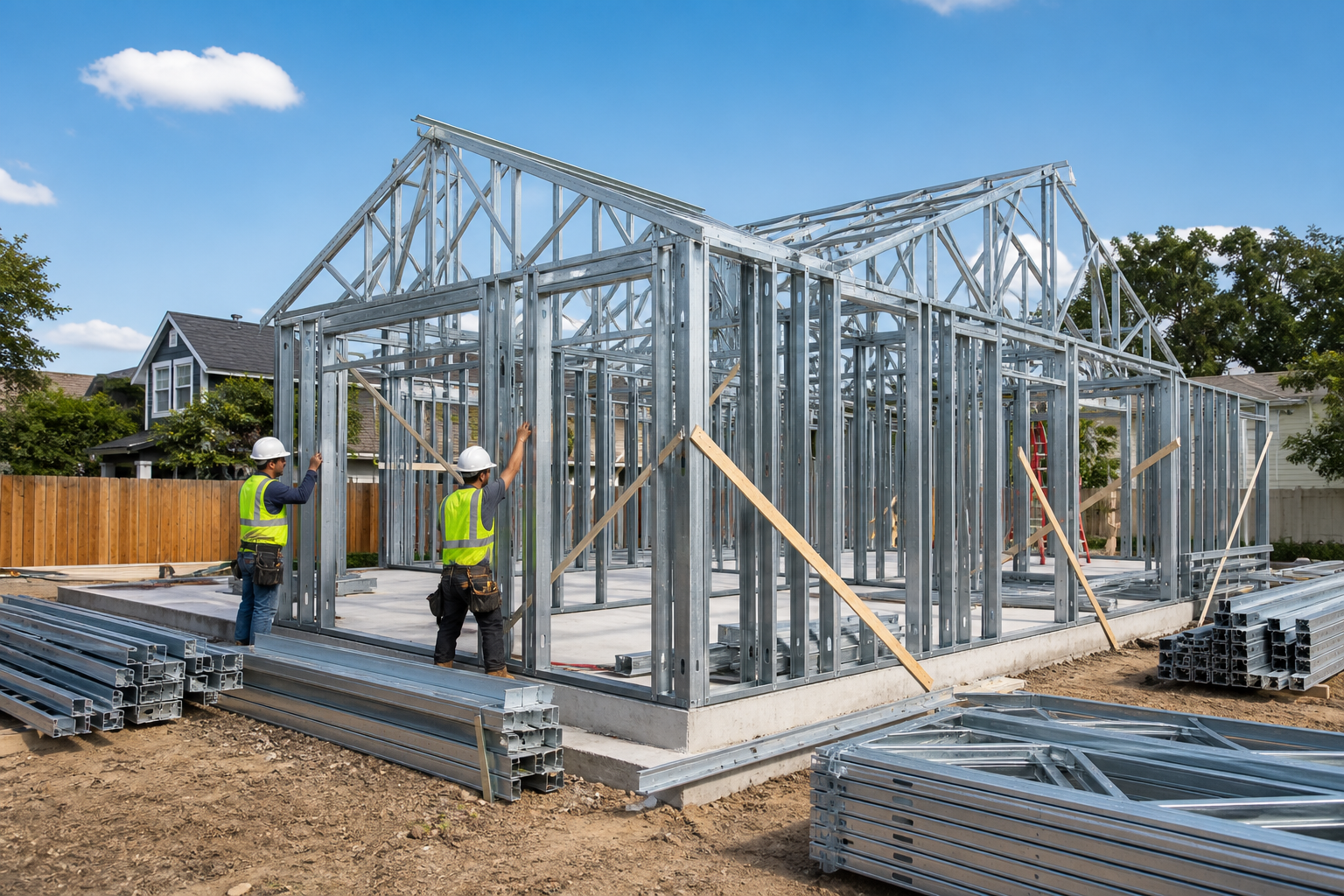
Wall assemblies, roof systems, structural components, openings, connection details, material quantities, and installation sequences can be planned before crews arrive on site. Repeated details can be reviewed once and used across multiple areas of a project. Components can be produced and organized around a defined assembly process.
This does not remove the need for skilled builders.
It gives them better information.
For homeowners and developers, that can mean clearer estimating, fewer avoidable changes, more predictable procurement, and a construction process that is easier to track.
Light Steel Framing Adds Precision
Light gauge steel framing is especially useful when cost certainty matters because it connects digital design to precise production.
Steel studs, tracks, joists, and trusses can be engineered, cut, punched, labeled, bundled, and delivered according to a coordinated plan. That helps reduce guesswork during installation.
In a light steel prefab system, the frame is not simply a collection of raw materials.
It is organized construction information.
Openings can be coordinated. Bracing can be planned. Roof geometry can be resolved earlier. Repeated components can be standardized. Material quantities can be clearer before the project reaches the most expensive stage of construction.
That precision supports construction cost control because the system reduces the number of places where the project must be reinvented in the field.
Material Waste Is a Cost Issue
Waste is not only an environmental issue. It is a budget issue.
When materials are ordered inefficiently, cut repeatedly, damaged on site, or changed late in the process, the project pays more than the purchase price. It also pays through disposal, labor, storage, handling, schedule disruption, and supervision time.
Prefab and light steel construction can help reduce waste because more material decisions are made through coordinated design and fabrication.
When components are produced to a plan, quantities become more transparent. When assemblies repeat, purchasing can become more disciplined. When parts arrive organized, crews spend less time sorting through uncertainty.
For developers building more than one unit, this can become a meaningful advantage. A detail that works on one home can be repeated and improved across the next.
Schedule Predictability Affects Financing
Cost certainty is also tied to time.
Every delay can carry financial consequences. Construction loans, carrying costs, temporary housing, equipment rentals, supervision, insurance, and opportunity cost all grow when a project takes longer than expected.
A faster project is valuable, but a more predictable project may be even more valuable.
Prefab construction can support schedule predictability because some work can be coordinated before site installation begins. Site preparation, design coordination, fabrication, and procurement can be aligned more deliberately. Once components arrive, the assembly process can follow a clearer sequence.
This matters in markets where affordability is already under pressure.
A project that controls both cost and time is easier to finance, easier to explain to buyers, and easier for developers to evaluate.
Cost Certainty Does Not Mean Less Design
One misconception about prefab is that predictability requires boring design.
That is not true.
The best housing systems separate meaningful choice from unnecessary complexity. Buyers can still care about layout, daylight, finishes, outdoor space, facade character, storage, energy systems, and overall lifestyle.
What they usually do not value is avoidable structural confusion.
A disciplined system can support design quality while standardizing the parts of the home that should be predictable: structural logic, component dimensions, connection details, service pathways, and assembly sequence.
That is not a reduction in quality.
It is a way to protect quality from the cost of disorder.
What Developers Should Ask Before Starting
Developers who want stronger cost certainty should ask practical questions early.
How many unique structural conditions does this design contain?
Which assemblies can repeat?
Are the major materials coordinated with real production dimensions?
Can the framing system be fabricated from clear digital information?
Are openings, roof geometry, and service routes resolved before construction?
How much cutting, measuring, and improvisation is expected on site?
Can the same construction system support future homes, ADUs, or communities?
These questions reveal whether a project is only designed to look good, or whether it is also designed to be delivered.
Where Xhome Fits
At Xhome, we approach housing as a coordinated path from design through fabrication and assembly.
Our light steel prefab system is intended to make construction clearer before the jobsite becomes expensive. The goal is to improve precision, reduce avoidable waste, support faster installation, and give developers and homeowners a more predictable process.
This matters for single-family homes, ADUs, infill housing, and residential communities where every delay or budget change can affect feasibility.
In a market where buyers are cautious and affordability is under pressure, homes need more than attractive renderings.
They need a construction system that can protect the budget behind the vision.
Final Thoughts
The next phase of homebuilding will reward clarity.
Buyers want to know what a home will cost. Developers want to know whether a project can pencil. Builders want fewer unresolved details. Lenders and investors want schedules that make sense.
Cost certainty connects all of those concerns.
Prefab construction and light steel framing cannot eliminate every risk in residential development. But they can move more decisions earlier, make the structure more precise, reduce avoidable waste, and create a clearer path from design to delivery.
In today's market, that kind of certainty may be one of the most valuable features a home can offer.
Sources: NAHB, Builder Sentiment Stays Weak as Affordability Concerns Persist; NAHB Eye on Housing, Building Material Prices Increase in July; U.S. Census Bureau, New Residential Sales.


